This is Part 1 of a 3-part series exploring the challenges of modern Accounts Payable (AP), the barriers to successful AP transformation, and how intelligent automation and connected workflows can help finance leaders build more efficient, scalable operations.
Finance leaders have spent years investing in automation to reduce manual work, accelerate invoice processing, and improve operational efficiency. Yet many organizations still find their Accounts Payable teams overwhelmed by exceptions, disconnected systems, and growing transaction volumes.
Why? Because automating individual tasks doesn't fix the process.
As invoice volumes increase, the limitations of traditional AP automation become more apparent. What worked for a smaller organization or a simpler finance environment may struggle to support the complexity of today's enterprise operations.
The challenge isn't simply processing more invoices – it's in managing everything that happens when an invoice doesn't follow the expected path.
When Automation Meets Real-World Complexity
An invoice is uploaded, data is extracted, and sent to an Enterprise Resource Planning (ERP) system for validation and payment. On paper, the process appears automated.
But what happens when...
-
The invoice is sent through a non-standard process?
-
There is no approved purchase order, or there's a duplicate?
-
A supplier submits an invoice with incorrect information?
-
An approval is delayed?
-
A discrepancy requires input from procurement, finance, or another department?
Suddenly, the automated process becomes a series of emails, spreadsheets, manual follow-ups, and disconnected conversations that happen outside the system of record and beyond the audit trail.
Unfortunately, these exceptions aren't unusual. They're part of everyday AP operations.
The problem is that many automation solutions were designed to process transactions, not necessarily to orchestrate the people, systems, and decisions required to resolve them.
Four Barriers to Successful AP Transformation
While automation can address many of the inefficiencies in accounts payable, successful transformation involves more than implementing new technology. Finance leaders must also navigate organizational complexity, disconnected systems, competing priorities, and the challenge of getting teams to embrace new ways of working.
Four common barriers can prevent organizations from achieving the full value of their AP modernization efforts.
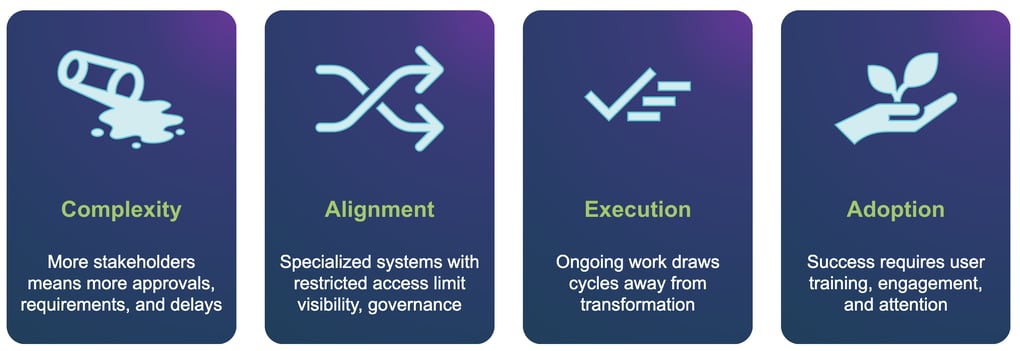
1. Complexity: More Stakeholders, More Challenges
As organizations grow, so do their approval processes, business requirements, and operational dependencies. Multiple departments, decision-makers, and financial systems can introduce delays and make even routine invoice processing more complicated.
Without clearly defined workflows and accountability, complexity can quickly undermine efficiency.
2. Alignment: Connecting Systems and Teams
Finance operations often rely on specialized systems with restricted access and limited visibility across departments. When these systems and teams aren't aligned, organizations struggle to maintain consistent governance, share information, and coordinate decisions.
Successful AP transformation requires connecting the people, processes, and technology involved throughout the invoice lifecycle.
3. Execution: Balancing Daily Operations with Transformation
Finance teams are responsible for keeping business operations moving while simultaneously supporting modernization initiatives. Managing invoices, resolving exceptions, and meeting payment deadlines can leave little time to focus on process improvements.
Without a practical implementation strategy, transformation projects can lose momentum as everyday responsibilities take priority.
4. Adoption: Making Change Stick
Even the most advanced automation solution delivers limited value if employees aren't equipped or motivated to use it.
Successful transformation requires user training, stakeholder engagement, and ongoing attention to how new processes affect daily work. Organizations must ensure that technology supports the people using it – not simply introduce another system to manage.
The Shift from Task Automation to Process Orchestration
Modernizing AP and building an invoice-to-payment process that will scale requires a broader perspective.
Rather than focusing exclusively on how quickly an invoice can be captured or processed, finance leaders should consider how work moves across the entire invoice lifecycle.
Who owns an exception? How is it routed? What information is needed to resolve it? How does that resolution flow back into the ERP?
These questions move the conversation from automation to orchestration.
At Genus Technologies, our approach to Financial Process Automation (FPA) focuses on connecting existing technology investments, improving the flow of work, and designing processes that can adapt as business requirements change.
The goal isn't simply to automate more tasks. It's to create an AP operation that can handle greater volume and complexity without a corresponding increase in manual effort.
So, What's the Solution?
Stay tuned for Part 2, where we'll explore how connected Accounts Payable Operations workflows can help finance teams address real-world exceptions, improve visibility, and keep invoices moving toward payment.
For a deeper conversation, watch the recorded webinar "AP Processes That Scale, Expedite Deployment, Expand Value & Embrace Agentic AI," presented by Genus and ServiceNow.
About the Author
Jennifer McNeill is Director of Financial Process Automation at Genus Technologies, specializing in Accounts Payable Orchestration (APO), intelligent automation, and finance modernization. She helps organizations streamline financial workflows, integrate existing systems, and improve operational efficiency through practical, technology-driven solutions. Connect with Jennifer on LinkedIn.
Subscribe
Genus Technologies is committed to providing our customers with insights into innovative technologies that drive efficiency, productivity, and success. Subscribe to the Genus blog so you don't miss the next installment!



 Genus Technologies : Jul 23, 2026