Your organization already has the information AI needs.
It's sitting in contracts, policies, customer correspondence, case files, images, videos, audio recordings, and decades of business documents. The problem is not a lack of content. It’s that much of that content is fragmented across repositories, difficult to search, inconsistently classified, or governed by systems that were never designed for the AI era.
AI is changing what organizations can do with enterprise content, but it is also exposing the weaknesses in how that content has traditionally been managed.
Part 1: The Challenge – Enterprise Content Wasn’t Built for the AI Era
For years, organizations added repositories and applications to solve specific business needs. Documents went into ECM systems and file shares. Teams collaborated via email or message channels. Attachments accumulated in SAP, IBM, Salesforce, JIRA, and ServiceNow®. Images and videos were stored in specialized platforms, shared drives, and cloud environments.
Each siloed system serves its purpose, but together they create a fragmented content landscape that is a barrier to collaboration, governance, and AI-enablement.
Employees struggle to identify the latest approved version. Important information remains buried inside scanned documents or video recordings. Metadata varies between departments. Permissions become outdated. Duplicate, obsolete, and redundant content continues to grow.
Then leadership introduces an enterprise AI initiative and expects the technology to make sense of it all.
That’s when the real issue becomes clear: the organization does not simply have an AI challenge. It has a content-readiness challenge.
Gartner predicts that through 2026, organizations will abandon 60% of AI projects unsupported by AI-ready data. The same principle applies to enterprise content. AI cannot consistently produce trusted answers from information that is outdated, inaccessible, poorly classified, or inadequately governed.
Part 2: The Transformation: Build an AI-Ready Content Foundation
Becoming AI-ready does not necessarily mean replacing every content platform or standardizing on a single repository. For most enterprises, that would be disruptive, cost prohibitive, and unrealistic.
A more practical strategy begins by connecting and improving the content environment that already exists.
AI can classify documents, recognize content types, extract names, dates and business terms, and apply meaningful metadata. Audio and video can be transcribed, translated and made searchable. Semantic search can identify information by meaning rather than relying solely on exact keywords.
Retrieval-Augmented Generation (RAG), can then connect generative AI with approved enterprise information. Instead of relying only on a model’s general knowledge, an AI assistant can retrieve relevant content from authorized sources and use it to construct a grounded response.
Imagine asking:
- Which contracts contain this renewal clause?
- What does our current policy say about this situation?
- What happened in similar customer cases?
- Where is the latest approved technical document?
- Which video discusses this product issue?
The technology is important, but connecting it with governance is what makes it useful. AI-powered retrieval must respect existing permissions, identify authoritative sources, and preserve retention, security, and audit requirements.
Modern content services bring documents and rich media into the same connected, governed information environment. Enterprise images, video and audio increasingly support claims, inspections, training, product development and customer service.
AI readiness also depends on the systems that manage, secure, and deliver enterprise content. Established Genus solutions such as Media Upshot for IBM ECM help organizations manage, search, and securely deliver rich media while maintaining native FileNet controls. Although Media Upshot is not an AI product itself, it helps create the accessible, governed, and scalable content environment that AI-enabled initiatives require.
The goal is not AI for its own sake. It is a connected content foundation that makes information understandable, discoverable, and ready to support the business.
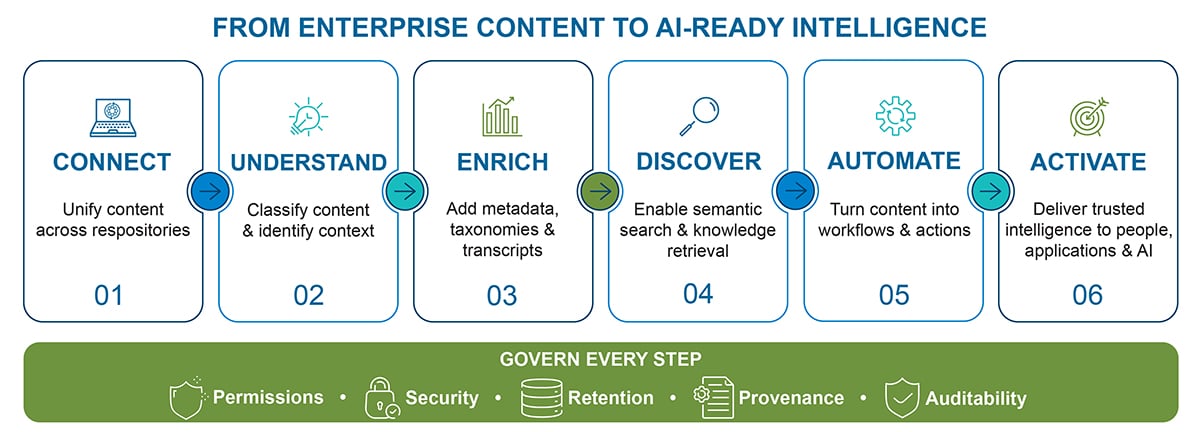
Part 3: The Result – Content Becomes Trusted Business Intelligence
When enterprise content is connected, enriched, and governed, its role changes.
Employees spend less time searching and more time using information. Documents and rich media become part of the same knowledge environment. AI responses can be grounded in approved sources. Workflows receive the context needed to route requests, identify exceptions, and support decisions.
Existing technology investments also gain new value. Instead of automatically replacing mature ECM platforms, organizations can extend them with modern search, cloud storage, APIs, automation, and AI capabilities.
Most importantly, connected content services turn distributed content repositories into a trusted intelligence foundation for people, processes, applications, and AI. It becomes the trusted intelligence layer connecting people, processes, applications and AI.
Building that foundation requires more than selecting a model or launching a new assistant. It requires a thoughtful strategy for content architecture, metadata, integration, governance, and lifecycle management. The content that is meaningful to the business and employees is the content foundation that will make the AI implementation an accelerator that drives collaboration and alignment.
Part 3: The Genus Partnership
With more than 25 years of experience in enterprise imaging, document management, automation and digital asset management, Genus Technologies helps organizations modernize complex content environments without losing the security, governance, or business context that makes their information valuable.
Explore Genus Enterprise Content Services to learn how your organization can move from content complexity toward AI-ready intelligence.
Subscribe
As a longtime Tungsten Automation and ServiceNow partner, Genus Technologies is committed to providing our customers with insights into innovative technologies that drive efficiency, productivity, and success. Subscribe to the Genus blog so you don't miss an article.
 Genus Technologies


 Randy Rowles : May 23, 2023