This is Part 1 of a 2-Part series on modernizing source-to-pay processes through integrating ServiceNow with SAP.
For many organizations, procurement and finance operations live in two different worlds: on one side, employees interact with intuitive service portals and request systems. On the other side, core financial processing happens inside ERP platforms.
When those systems don’t talk to each other effectively, teams are left dealing with manual data entry, disconnected workflows, and slow approval cycles. That’s where integration between ServiceNow and SAP becomes critical.
At Genus Technologies, we work with organizations that want to streamline procurement processes without disrupting their core financial systems. By connecting ServiceNow workflows directly with SAP, organizations can modernize the user experience while maintaining the integrity and power of their ERP.
The result is a faster, more connected source-to-pay process. So what does this look like in practice? Let’s break it down.
The Challenge: Disconnected Procurement Systems
In many enterprises, procurement begins in one system and finishes in another.
An employee might submit a request in a service portal, but the actual purchase order creation, supplier management, and financial processing happen in SAP. Without proper integration, this creates friction at nearly every step:
- Manual re-entry of request data into ERP
- Limited visibility into approval or order status
- Delays between request submission and PO creation
- Increased risk of errors or duplicate records
- IT teams managing complex custom integrations
Over time, these inefficiencies compound. Procurement teams struggle to maintain visibility, finance teams spend time correcting errors, and employees experience delays that affect productivity.
Modern organizations are looking for a way to connect these systems more intelligently.
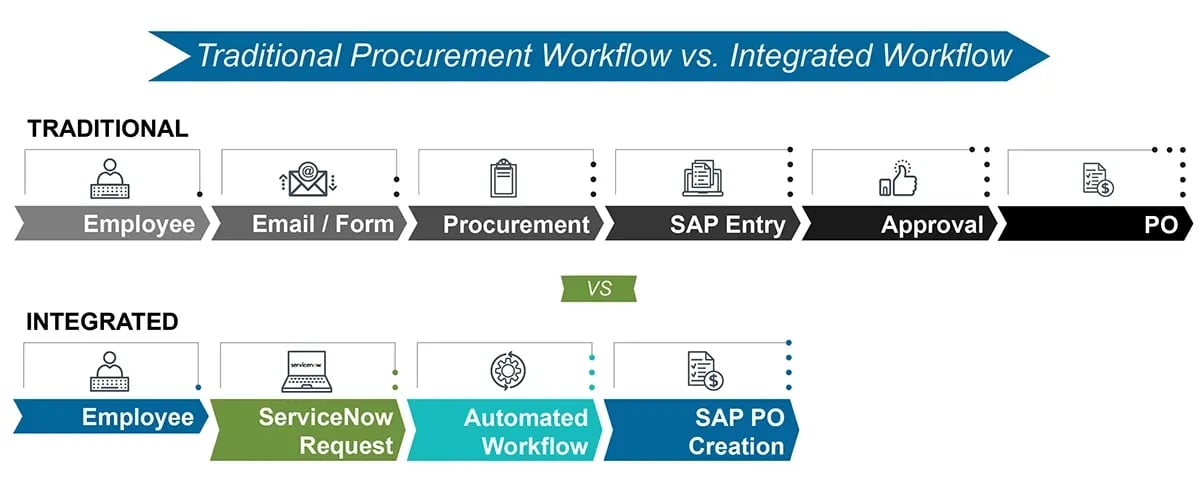
A Better Approach: ServiceNow as the Front Door to Procurement
ServiceNow has become the preferred entry point for many internal services across the enterprise, from HR requests to IT support and employee workflows.
Extending that same experience to procurement is a natural next step.
When ServiceNow is integrated with SAP, employees can submit procurement requests through a familiar, streamlined interface while the underlying financial processes remain securely managed in SAP.
This approach delivers several advantages:
1. A Simplified Request Experience
Employees no longer need to navigate complex ERP interfaces.
Instead, they can submit procurement requests directly through ServiceNow, using guided forms and automated workflows designed to capture the necessary information up front.
2. Automated Data Flow to SAP
Once a request is approved in ServiceNow, key data is automatically transmitted to SAP to generate the appropriate purchasing documents.
This eliminates the need for manual data entry and reduces the likelihood of transcription errors.
Automation ensures that procurement teams can move faster while maintaining compliance with financial policies and controls.
Learn How ServiceNow + SAP Modernizes Source-to-Pay with a System of Action
3. Real-Time Visibility Across Systems
One of the most common frustrations in procurement is the lack of transparency after a request is submitted.
With integrated workflows, users can track the status of their request directly within ServiceNow, even as the transaction progresses through SAP.
This creates a more transparent experience for employees while giving procurement teams greater operational oversight.
4. Reduced IT Complexity
Traditional integrations often rely on brittle custom code that becomes difficult to maintain.
Modern integration frameworks allow organizations to establish structured, scalable connections between ServiceNow and SAP, reducing long-term technical debt and improving reliability.
For IT teams, this means fewer support tickets and easier system upgrades
To rein in these hidden costs, you need two things:
1. A well-defined archiving policy – Decide:
- Which Attachments must stay in ServiceNow (recent, mission-critical, accessed frequently)
- Which can be archived (old, rarely accessed, very large)
- Criteria: age, size, type, etc.
2. Automation + external storage – Because manual cleanup is error-prone and doesn't scale. This is where Genus Attachment Archiver comes in – it's built to give you both the policy and the mechanism.
Turning Procurement into a Connected Experience
When ServiceNow and SAP operate as a connected ecosystem, procurement becomes significantly more efficient.
Employees gain a simple, intuitive way to request goods and services. Procurement teams gain better visibility and control. Finance teams benefit from accurate, automated data flowing into the ERP.
Instead of forcing employees to work around disconnected systems, organizations can create a procurement experience that feels unified from request to payment.
The Genus team helps organizations design integrations that align procurement workflows with their financial systems without sacrificing usability or governance.
In our next post, we’ll take a closer look at what this integration actually looks like in action, including how requests move from ServiceNow into SAP and how automation can accelerate the entire source-to-pay process.
Genus and ServiceNow teamed up for a live discussion on Simplifying Source-to-Pay with ServiceNow + ERP Integrations
In Part 2 of this series – Integrating ServiceNow + SAP: Bridging the Gap Between Procurement & SAP, we explore what the integration looks like day-to-day. In just four easy steps, we'll walk through how that process typically works and what you can expect along the way.
Subscribe to the Genus blog so you don't miss the next installment.
 Genus Technologies




 Genus Technologies : Apr 22, 2026